Why your body feels so stiff by 9 p.m. (it's your day, not you)
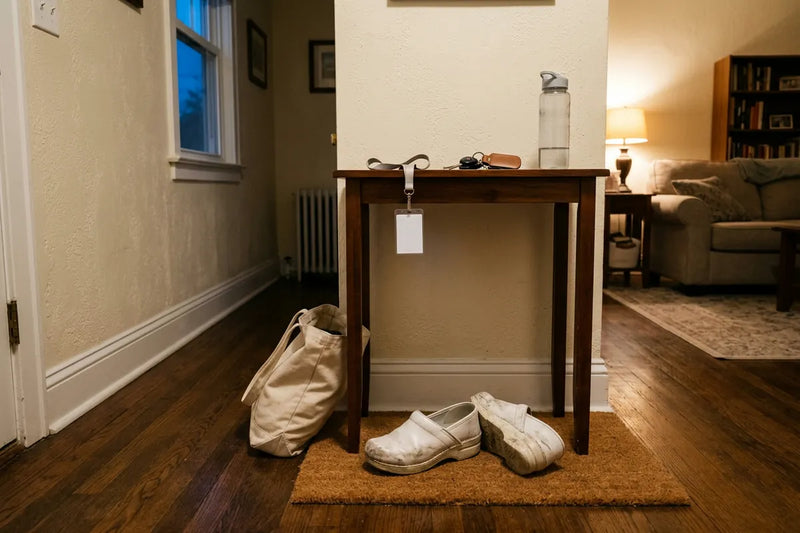
It's 8:47 p.m. You've been up since 5:50. Maybe it was twelve hours on hospital floors. Maybe it was eight at the register, then driving your mom to her appointment and getting dinner on the table. You finally sit down, and the second you stop moving your calves start to throb and your lower back feels laced too tight. You get up for a glass of water and walk the first three steps like you're 80.
Then the thought shows up: what's wrong with me?
Probably nothing. End-of-day stiffness is usually the bill for the day you just had. Hours on your feet, or hours in one chair, leave your muscles and the fascia around them tight. Fascia is the thin web of connective tissue that wraps every muscle, and when it tightens it can limit how freely you move. It's a load problem, not a flaw in you.
What is fascia, in plain words?
Picture the thin, see-through layer on a chicken breast before you cook it. That's fascia. The Cleveland Clinic describes it as the band of thin, fibrous connective tissue that wraps around and supports every structure in your body [1]. It's one continuous web: around each muscle, between muscles, under your skin.
When it's happy, it glides and you move without thinking. When it gets tight, it can restrict your muscles and the tissue around them [1]. That's the laced-too-tight feeling. Because the web is continuous, stiffness often feels like it's everywhere at once instead of in one clear spot.
Why standing all day and sitting all day end up in the same place
You'd think a nurse who walks miles a shift and an office manager who barely leaves her chair would feel different at night. Often they don't. Both spend hours in one kind of load.
- Standing: U.S. civilian workers spend 55.1% of the workday standing, according to the Bureau of Labor Statistics [2]. For nurses, retail workers, teachers and caregivers it's a lot more.
- Sitting: total daily sitting time for U.S. adults went from 5.5 to 6.4 hours between 2007 and 2016, a JAMA study found [3].
Muscles like to change position. Hold one posture for hours, upright on hard floors or folded into a chair, and the tissue stays loaded the same way. The Cleveland Clinic lists long stretches of sitting and poor posture among the things that tighten fascia [1]. By evening you feel the whole day at once.
You're not imagining it
Women in their 40s and 50s describe this in almost the same words. "Everything just hurts and I don't know why!" one 50-year-old wrote on Mumsnet, in a thread about aching all over [4]. She isn't rare. In 2019, 39.0% of U.S. adults had back pain and 36.5% had pain in their legs or feet in the previous three months, according to the CDC [5].
That's not a niche problem. It's the ordinary cost of heavy days, and it says more about the day than about the body living it. Hormones can play a part too, especially around perimenopause, and that's a good conversation to have with your doctor. But the stiffness you feel at 9 p.m. after a ten-hour shift has a simpler explanation sitting right there in your calendar.
What helps tight muscles and fascia at the end of the day?
If the cause is hours in one position, the answer is to give tight tissue something different: movement, warmth and steady pressure or vibration. The Cleveland Clinic's own list for keeping fascia healthy includes staying active, stretching, heat, foam rolling and massage [1].
The catch is timing. Most of those need effort, and at 9 p.m. you have none left. That's the real reason so many good massagers go unused, which we get into in why the massage gun ends up in the drawer. On a tired night, the version that asks least of you wins:
- Move for two minutes before you sit: a few calf raises, a slow forward fold, some shoulder rolls.
- Get your legs up on a cushion or the arm of the couch for a while.
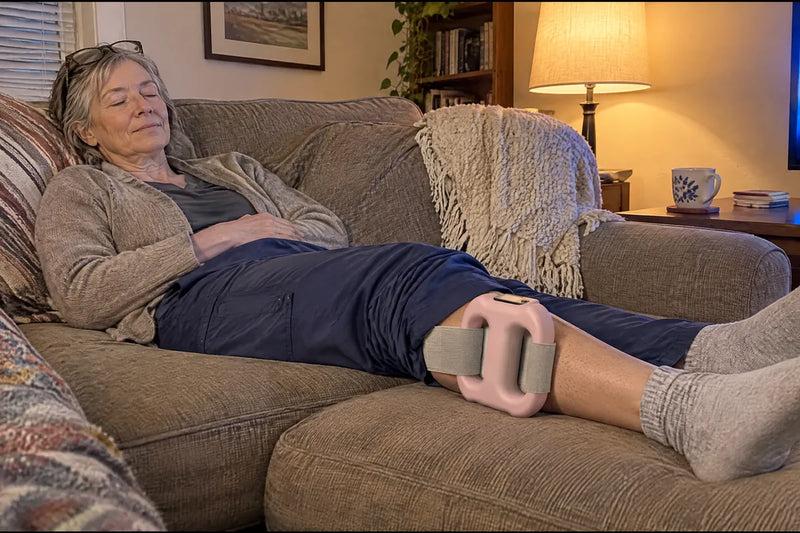
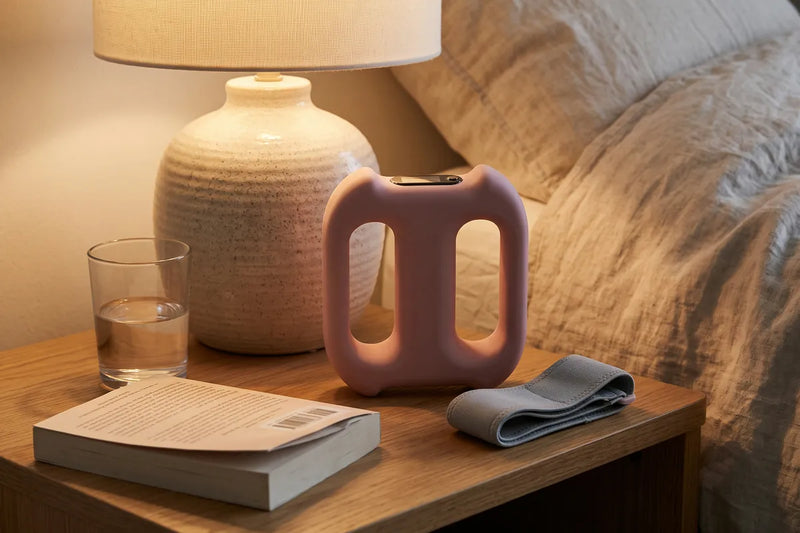
- Give tight muscles steady vibration while you rest. It helps muscles and fascia let go of the day's tension, and you don't have to hold anything. Here's the 10-minute couch ritual we suggest.
- Finish with something warm: a shower, a bath or a heating pad on low.
When should you talk to a doctor?
Stiffness that eases with rest is one thing. See a doctor if the pain is sharp, getting worse or waking you at night, if it comes with swelling, redness or numbness, or if one leg is suddenly swollen, warm or tender. That isn't end-of-day stiffness, and no massager is the answer to it.
Questions people ask
Why do I feel stiffer at night than in the morning?+
Because the day's load adds up. Hours standing or sitting in one position leave muscles and the fascia around them tight, and you notice it most when you finally stop moving in the evening.
What is fascia?+
Fascia is a thin, fibrous web of connective tissue that wraps around and supports every muscle and structure in your body. When it's healthy it glides; when it gets tight it can limit how freely you move.
Can tight fascia make my whole body feel stiff?+
It can feel that way. Fascia is one continuous web, so tightness often feels spread out rather than in one spot. Movement, stretching, warmth and massage all help it loosen.
Is feeling stiff after a long shift normal?+
Yes, for most people it's the normal result of a heavy day. Talk to a doctor if the pain is sharp, getting worse, wakes you up, or comes with swelling, redness or numbness.
Sources
- Cleveland Clinic, "Fascia". https://my.clevelandclinic.org/health/body/23251-fascia
- U.S. Bureau of Labor Statistics, "Sitting and standing" (Occupational Requirements Survey). https://www.bls.gov/ors/factsheet/sit-and-stand.htm
- Yang L. et al., "Trends in Sedentary Behavior Among the US Population, 2001-2016", JAMA, 2019. https://pubmed.ncbi.nlm.nih.gov/31012934/
- Mumsnet, "Aaaarrrghhh perimen and total body aches", 2025. https://www.mumsnet.com/talk/_chat/5364114-aaaarrrghhh-perimen-and-total-body-aches
- CDC, NCHS Data Brief 415, "Back, Lower Limb, and Upper Limb Pain Among U.S. Adults, 2019". https://www.cdc.gov/nchs/products/databriefs/db415.htm
Not medical advice. This article is general information, not a diagnosis or a substitute for care from your doctor. The Evenhour ring is a personal massager for relaxation and comfort, not a medical device. If pain is severe, getting worse or comes with swelling, redness or numbness, see a doctor.