Vibration and muscle recovery: what the research actually says
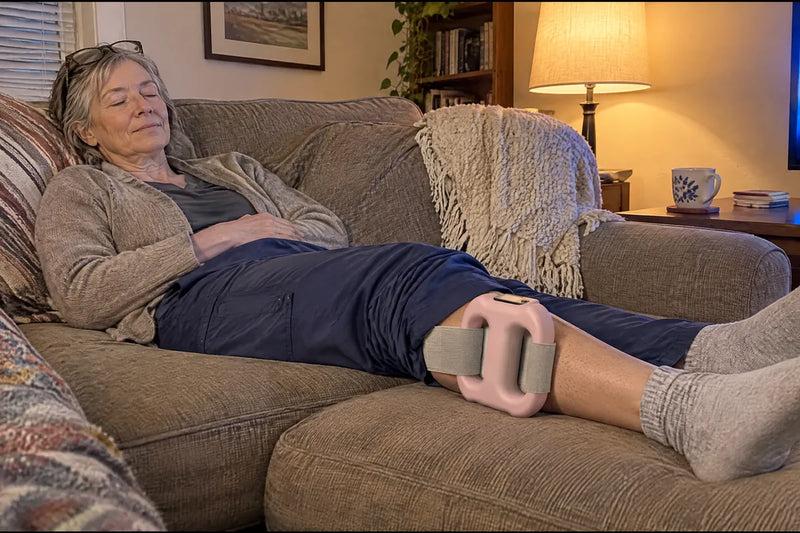
You're on the couch after a long shift, scrolling past an ad with a slow-motion muscle rippling under a massage gun. "Professional strength." "Deep tissue." And a small voice says that if it doesn't hurt a little, it probably isn't doing anything.
So can a steady, gentle buzz actually help a tired body? Here's what the research says, without the hype.
Yes. Vibration has real research behind it for muscle recovery. A 2019 meta-analysis of 10 randomized trials with 258 people found vibration significantly reduced muscle soreness at 24, 48 and 72 hours after exercise [1]. A 2022 meta-analysis found it lowered pain scores and raised pain threshold after hard exercise [2]. For winding down at night, the right strength is the one you can relax under.
What did the studies look at?
Most of the research is on delayed-onset muscle soreness, the stiff, achy feeling a day or two after unusual effort. Researchers had people do hard exercise, then gave one group vibration and the other group nothing or a comparison treatment, and tracked soreness and blood markers of muscle damage over the next few days.
What did they find?
- Lu et al., 2019, Journal of International Medical Research: 10 trials, 258 participants. Vibration "significantly improved" soreness scores at 24, 48 and 72 hours after exercise and lowered a muscle damage marker (creatine kinase) at 24 and 48 hours. The authors call vibration "a beneficial and useful form of physiotherapy" for this kind of soreness [1].
- Yin et al., 2022, Medicine: vibration "effectively reduced the subjective pain sensation" after this kind of soreness, "increased the pain threshold" and was linked to faster muscle repair than control treatments [2].
Put simply: when muscles are worked hard and left sore, vibration helps them recover and feel better sooner. That is the core of what a vibrating massager does for you after a long day.
What the research doesn't cover yet
We'd rather you hear this from us. The studies are fairly small, and the 2019 authors say more research is needed to pin down exactly how vibration works [1]. Most trials looked at soreness after exercise, not after a ten-hour shift, and they used a mix of devices. They measured soreness and muscle markers rather than fascia directly, because fascia is hard to measure on its own.
None of that changes the direction of the findings. It just means the honest claim is "helps muscles recover and feel looser," not "fixes everything."
Why does vibration feel good on tight muscles and fascia?
Steady vibration keeps the tissue moving gently for minutes at a time, which is exactly what hours of standing or sitting take away. Recovery brands describe it the same way: Hyperice explains vibration as pulses that reach into the muscle and help loosen the layers of fascia around it [3]. The Cleveland Clinic includes massage among the ways to keep fascia healthy [4]. What you feel is simple: the spot loosens, the heaviness eases and your body gets the signal that the day is over.
Is stronger better? Not at 9 p.m.
More force isn't automatically more benefit. Around 1900, the Battle Creek sanitarium had a vibrating chair. The Museum of Questionable Medical Devices sums it up: "The chair shakes rather violently and is painful to sit in" [5]. Nobody wanted to use it, which made it useless.
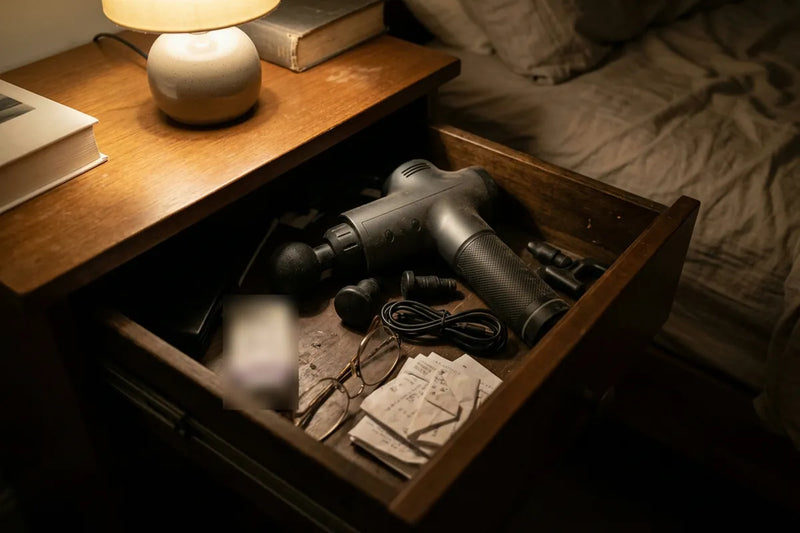
The same thing happens at home. A percussion gun at full blast is great on a gym day. At night you want something you can lie under for fifteen minutes with your eyes closed. The setting you relax under is the one you'll actually use, and the one you use is the one that helps.
| Percussion gun | Wearable vibrating ring | |
|---|---|---|
| Motion | Fast, hard pounding | Steady vibration, 8 levels |
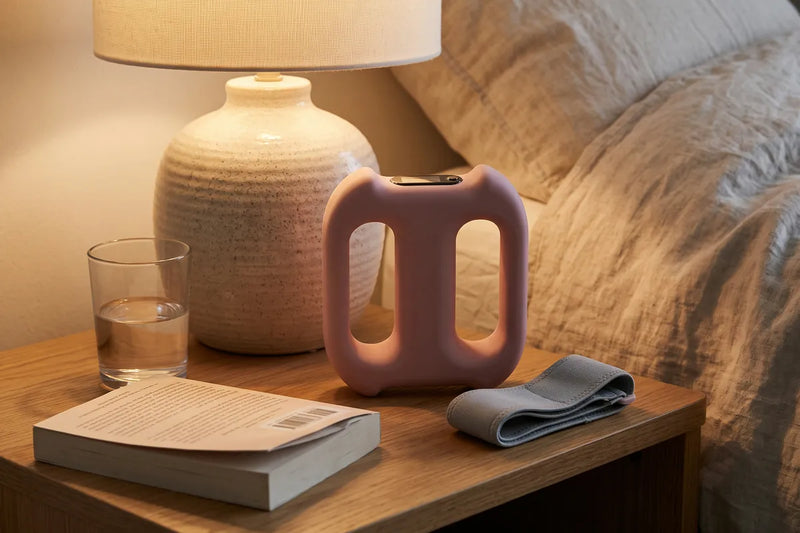
| How you use it | Hold and aim it | Strap it on and rest |
| Best moment | After a workout, when you have energy | Evening, on the couch or in bed |
| What it asks of you | Arm strength and reach | About ten seconds |
How to use vibration for recovery at home
- Pick the muscles that worked hardest today.
- Start on a low level and go up only if it feels good.
- Give each spot 10 to 15 minutes, then move on.
- Do it most nights. Steady habits beat occasional marathons.
The full routine is in the 10-minute couch ritual. And if you're tired of ads that promise the moon, read what a fascia ring can honestly promise you.
Questions people ask
Does vibration help muscle recovery?+
Yes. A 2019 meta-analysis of 10 trials found vibration significantly reduced muscle soreness at 24, 48 and 72 hours after exercise, and a 2022 meta-analysis found it lowered pain scores and raised pain threshold.
Does vibration help fascia?+
Steady vibration keeps muscles and the fascia around them moving gently, which helps tight tissue loosen. Studies have mostly measured soreness and muscle recovery, since fascia is hard to measure on its own.
Is gentle vibration strong enough?+
For winding down at night, yes. The goal is relaxing tight muscles while you rest, and a strength you can relax under is the one you'll use often enough to feel the difference.
How often should I use a vibrating massager?+
Most nights, for about 10 to 15 minutes per spot, works well for most people. Consistency matters more than intensity.
Sources
- Lu X. et al., "Does vibration benefit delayed-onset muscle soreness?: a meta-analysis and systematic review", Journal of International Medical Research, 2019. https://pubmed.ncbi.nlm.nih.gov/30526170/
- Yin Y. et al., "The effect of vibration training on delayed muscle soreness: A meta-analysis", Medicine, 2022. https://pmc.ncbi.nlm.nih.gov/articles/PMC9592333/
- Hyperice, "Benefits of vibration massage". https://hyperice.com/blog/massage/benefits-vibration-massage/
- Cleveland Clinic, "Fascia". https://my.clevelandclinic.org/health/body/23251-fascia
- Museum of Questionable Medical Devices, "Battle Creek Vibratory Chair". https://museumofquackery.com/devices/k-chair.htm
Not medical advice. This article is general information, not a diagnosis or a substitute for care from your doctor. The Evenhour ring is a personal massager for relaxation and comfort, not a medical device. If pain is severe, getting worse or comes with swelling, redness or numbness, see a doctor.